



Healthy Minds X SOLANGE
On 29 April, the time had come: Our SOLANGE network was finally rolled out at the surgery building of theMedical University of Innsbruck.
We have been working on this project together with artist Katharina Cibulka and her team for months and we are very pleased that we can now give the topic of perinatal mental health a public space in this way.
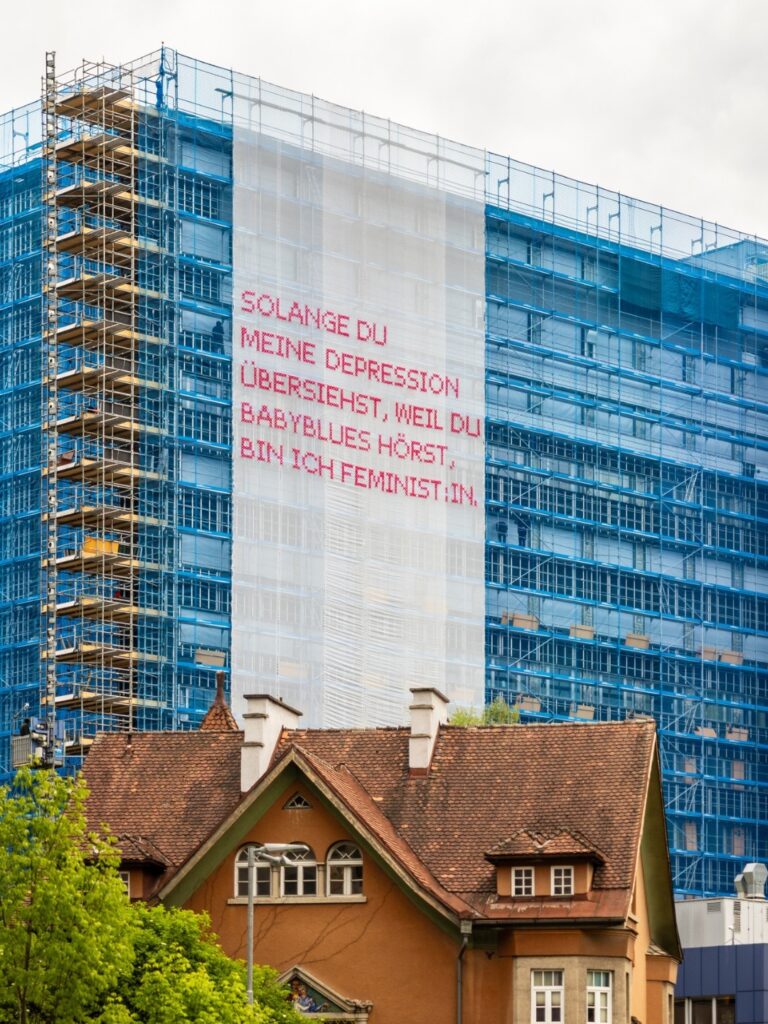
SOLANGE #34, Innerkoflerstraße, 2026 (Photo: Florian Lechner)
„AS LONG AS YOU OVERLOOK MY DEPRESSION, BECAUSE YOU ONLY HEAR BABYBLUES, I AM A FEMINIST”
resulted from around 350 submissions as part of the SOLANGE postcard campaign.
Especially on social media platforms such as Instagram and Reddit, the slogan led to discussion and incomprehension.
And this is exactly where we want to start: There is too little information about the time and complications surrounding the birth and there is too little differentiation – and we want to change that through our awareness campaign!
What exactly are Baby-Blues?
Baby blues occur in 50 to 80 percent of all mothers within the first 14 days after delivery. It usually lasts a few hours to a few days and is manifested by symptoms such as tiredness and exhaustion, sensitivity and mood swings, sadness and frequent crying, insomnia and restlessness as well as concentration, appetite and sleep disorders.
Although the baby blues are considered as a normal, temporary (non-pathological) reaction to the physical and hormonal changes after pregnancy or childbirth, it should not be ignored. If it lasts for more than two weeks, it could be a sign of depression.
Perinatal depression can occur during pregnancy and in the first two years after childbirth, especially in the first few weeks after delivery. This condition can develop slowly and ranges from mild adjustment disorders to severe forms that include suicidal thoughts. About 10 to 20 percent of mothers are affected by these conditions.
Possible signs include:
- Exhaustion, fatigue and lack of energy
- Frequent crying and persistent sadness
- Feelings of guilt and inner emptiness
- Ambivalent feelings towards the child
- Problems with concentration, appetite and sleep
- Psychosomatic complaints such as headaches, dizziness and heart problems
- Fears, severe irritability, panic attacks and obsessive thoughts (recurring destructive ideas that are not put into action)
- Suicidal thoughts
The problem: Depression is often dismissed as the baby blues – also due to the great stigma – which means that parents do not seek timely and adequate treatment and their condition often worsens.
SOLANGE X HEALTHY MINDS – YOUR OPINION MATTERS!
We would like to read a wide variety of opinions on the installation and the slogan in order to be able to assess the impact in terms of raising awareness in mental health. This is where YOU come in.
What do you think? We’d be interested in your opinion!
Take part in our short, anonymous survey (3-5 min.) and support our Healthy Minds research project.
PARTICIPATE HERE OR SCAN THE QR-CODE:

Press articles:
https://www.i-med.ac.at/de/pr/presse/2026/kunst-auf-der-chirurgie-baustelle
https://tirol.orf.at/stories/3352214