



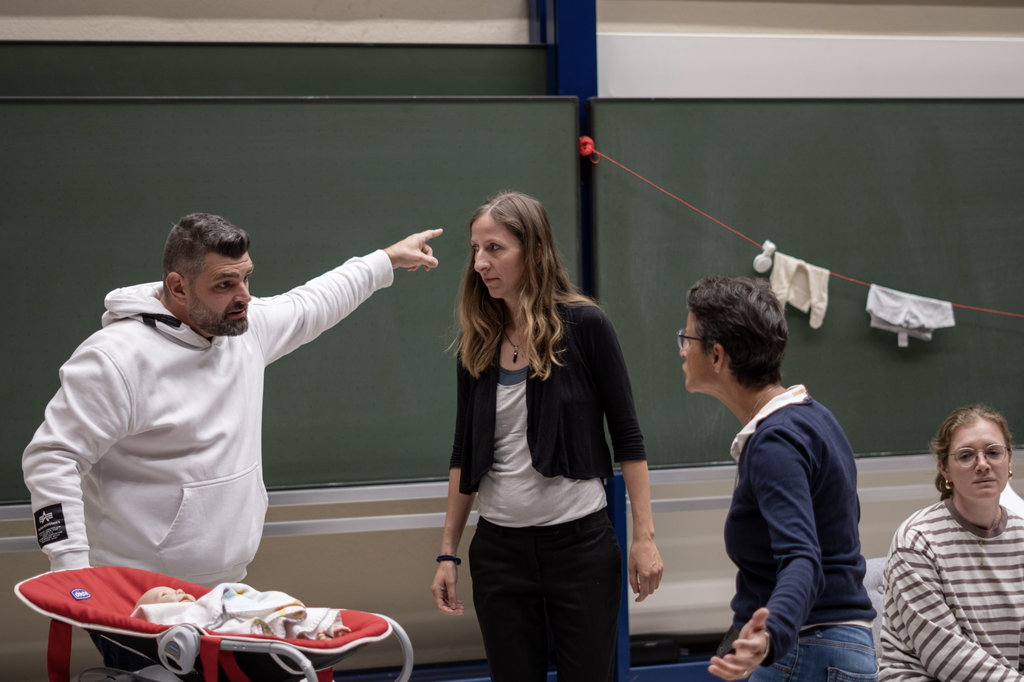
Forum Theatre at “Healthy Minds in Dialogue”; from left to right: Markus Presslauer, Andrea Umhauer, Bettina Schlechter, Lara Herbrich | Photo: Kristian Schwab
On 23 and 24 September 2026, the Frauen-Kopf-Klinik in Innsbruck became a meeting place for people who deal with mental health around pregnancy, birth and early parenthood from various perspectives.
With our knowledge transfer event Healthy Minds in Dialogue: Mental Health around Childbirth, financed by the Austrian Research Funding (FWF), we wanted to bring together current research with practical experience and the knowledge of people with lived experience. Together, the aim was to convey knowledge in an understandable way, to strengthen the exchange between research, care and those affected, and to open up new perspectives for perinatal mental health.
The result was one and a half intensive days full of encounters, discussions, new insights and shared ideas.
When lived experiences come to the stage
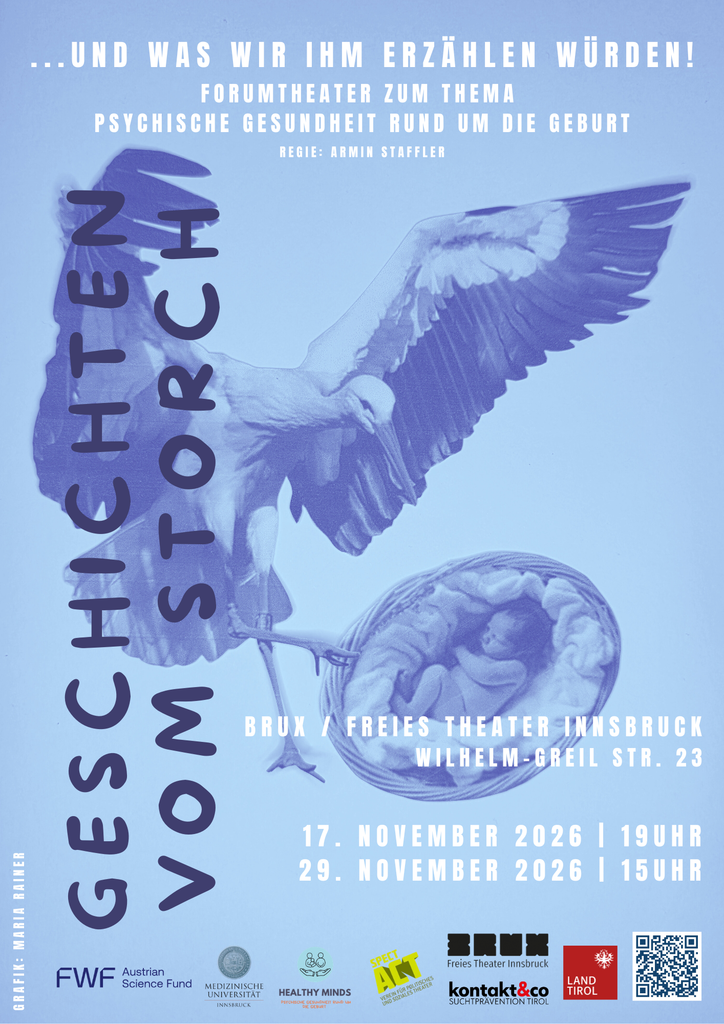
The kick-off on Wednesday was all about raising awareness and lived experience. After some welcoming words and an insight into our awareness campaign, it became interactive: At the Forum Theatre “Stories of the Stork”, people with lived experience brought situations to the stage together with theatre educator Armin Staffler which deal with mental health around birth.
The people in the audience did not just remain spectators: The Forum Theatre invited people to look at situations together, change perspectives and think about what could be different in difficult moments.
We are happy to announce that two more Forum Theatre performances will take place in the course of November and are looking forward to lots of visitors at the Brux / Freies Theater Innsbruck:
Research meets experience and healthcare

International Perspectives on Perinatal Mental Health: Dr.in Annette Bauer and Dr. Prof. Assoc. Campbell Paul with Impulses from Health Economics and Infant Mental Health | Photo: Kristian Schwab
On the second day of the event, the focus was on the exchange between science, health care, psychosocial practice and people with lived experience.
In her keynote speech, Dr.in Annette Bauer from the London School of Economics and Political Science showed why investing in perinatal mental health can also be worthwhile from a health economic point of view. She illustrated the far-reaching costs that mental issues entails for families, the health care system and society and how economic analyses can help to use limited resources as effectively as possible. The focus was also on the question:
How can we invest early in order to achieve better results for families and society in the long term?
After this keynote, our Healthy Minds team gave insights into the development of the research project so far. Among other things, research results were presented on the experiences of mothers with peer support as well as later in the day on perinatal mental health of fathers and the potential of digital self-screenings in the field of perinatal mental health.
With Dr. Assoc. Prof. Campbell Paul from Melbourne, another international perspective was added: His contribution focused in particular on the baby and the early parent-child relationship. Using Newborn Behavioral Observations (NBO), he showed how close observation can help to better understand the signals, strengths and needs of a newborn. In this way, not only can the parents’ understanding of their baby be strengthened, but also the early parent-child relationship, especially in situations in which parents themselves are mentally stressed.
Many perspectives – one common question
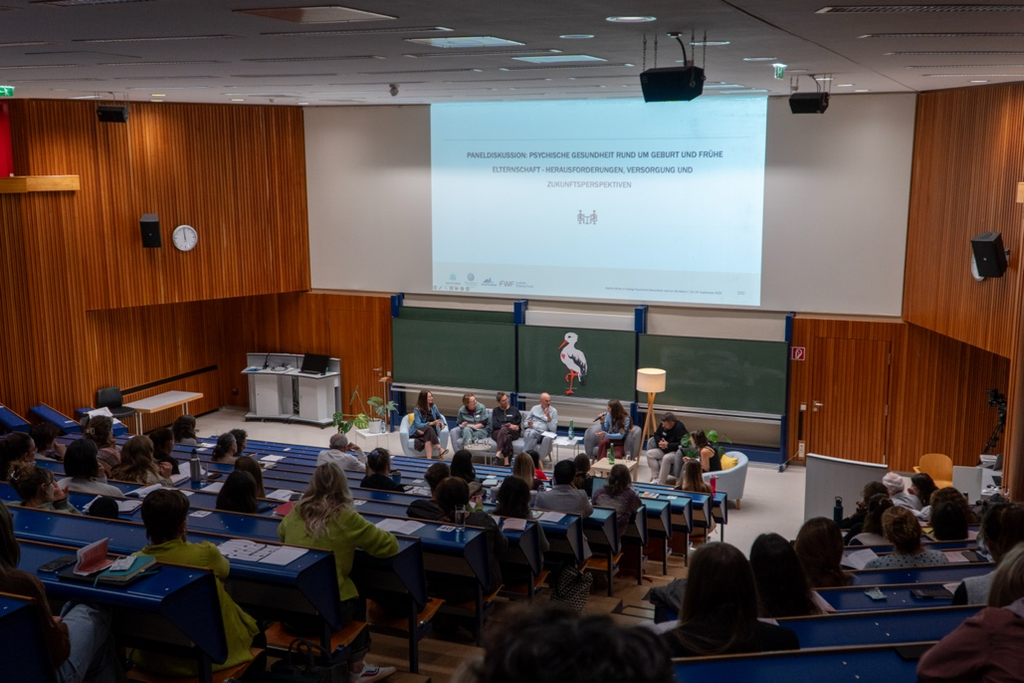
Discussing together: different perspectives on care, challenges and future perspectives. | Photo: Kristian Schwab
A special room for different perspectives was created in the panel discussion on the challenges, care and future prospects of mental health around birth and early parenthood.
With health economics, psychiatric care, midwifery and psychotherapy perspectives as well as people with lived experience, different perspectives deliberately came together. Part of the panel were Dr.in Annette Bauer, Dr.in Christine Hörtnagl, Martina König-Bachmann, Anna Oberdorfer, Markus Presslauer and Dr.in Ingrid Zechmeister-Koss.
The focus was not only on the question of where gaps in care currently exist, but also on how knowledge, existing offers and different worlds of experience can be better combined in the future.
HERE you can find out more about all panel discussion participants.
Not only listening, but also participating
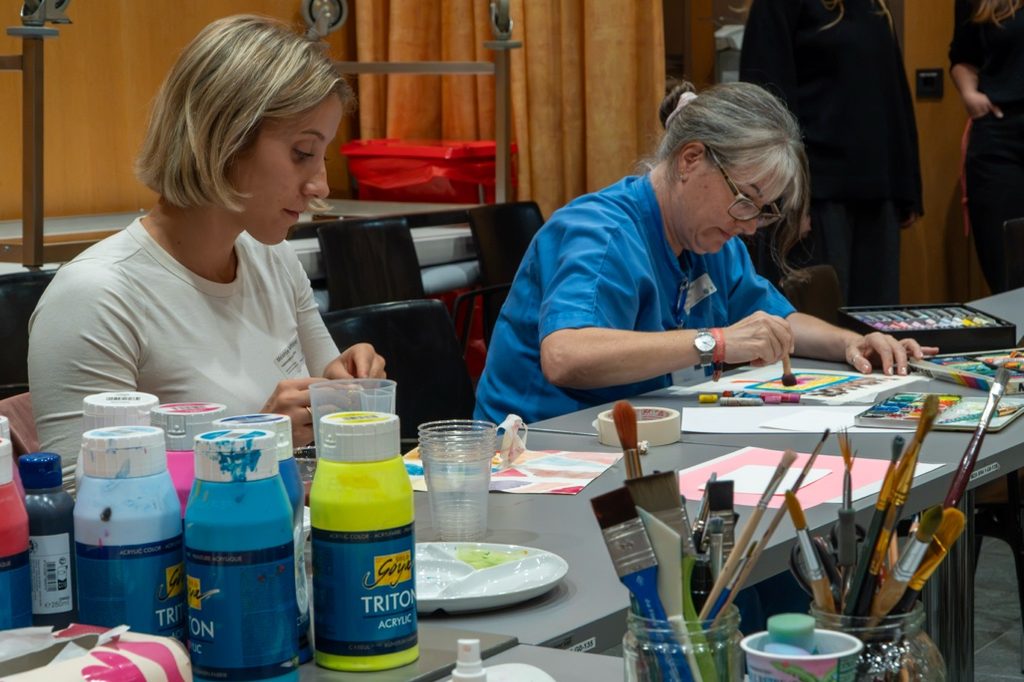
In the creative room, mental health also became a topic through joint creation. | Photo: Kristian Schwab
In the afternoon, listening turned into participation and trying things out. In four parallel workshops, the participants were able to learn about different approaches to perinatal mental health and think ahead together. The spectrum ranged from the practical work of the special consultation hour to trauma-informed care and the early parent-child relationship to creative methods in an art therapy setting:
From case to case
Psychiatrist Dr.in Christine Hörtnagl and clinical psychologist Luna Rabl gave interactive insights into the Perinatal Mental Health Specialty Clinic. The focus was on case studies, common myths and possibilities for early detection and support.
Acting in a trauma-informed manner
Dr.in Marta Caccamo and Tamara Borbola worked with their workshop participants in the sense of Emmi Care to make trauma-informed principles tangible and practically applicable for everyday perinatal care.
Supporting the Infant-Parent Relationship
Child psychiatrist Dr. Assoc. Prof. Campbell Paul introduced the Newborn Behavioral Observations (NBO) and showed how close observation of a baby can help to support parents in understanding their child and in their early relationship.
Creative Room – Creating together for a good start in life
With Art therapist Maria Rainer, creativity became a low-threshold access point for encounter, reflection and exchange in relation to peripartum mental health.
HERE you can read more about the respective speakers and the workshops.
Exchange that goes beyond the event
A central goal of our event, Healthy Minds in Dialogue, was to bring together people with different perspectives on mental health around birth, whether professional, scientific or based on personal experience.
Many of the conversations therefore took place not only on stage: new contacts, ideas and networks were also created during the breaks, in the workshops, over shared meals and through personal exchange.

For us, sustainable knowledge transfer does not only mean presenting research findings. It also means sharing knowledge with one another, learning from each other and thinking together about what can change in care.
Thinking ahead together: Alliance for Perinatal Mental Health
As Dr.in Annette Bauer’s keynote speech made clear, we would like to follow the example of the UK and the “Global Alliance for Maternal Mental Health”, co-founded by Dr. Alain Gregoire, and, together with you, lay the foundation for the creation of a national alliance for perinatal mental health in Austria.
As a first step, we’d like to offer you the opportunity to participate in an online meeting. The goal is to exchange initial ideas and suggestions for potential collaboration and networking in Austria.
Are you interested in participating?
If so, please register via this link by October 16, 2026. We will then inform you of the date and further details.
Please feel free to share the link within your network and with individuals or organizations interested in jointly advancing perinatal mental health in Austria.
What remains?

Some of the people who organised “Healthy Minds in Dialogue”; from left to right: Dr.in Jean Paul, Dr.in Annette Bauer, Laura Hölzle, Marie Sonnenstuhl, Armin Staffler, Laetitia Watzke, Dr. Assoc. Prof. Campbell Paul, Philipp Schöch, Dr.in Marta Caccamo | Photo: Kristian Schwab
What remains of these one and a half days are not only new insights, but also encounters, conversations, ideas and new networks.
We would like to thank everyone who made Healthy Minds in Dialogue possible and brought it to life:
our Speakers and Workshop leaders,
our Cooperation partners and supporters,
all the people, who contributed their personal experience,
and of course all participants, who contributed to the exchange with their questions, thoughts and perspectives.
Thank you for joining us in making mental health around childbirth visible.
Stay in DIALOGUE with Healthy Minds.
Even after the event, we would like to continue the DIALOGUE around mental health around childbirth.